

Why I ❤️ "The Giver" by Lois Lowry
The Books We ❤️ Club welcomes Meg Oolders of Beautiful, Daring, Stupid


Somehow, despite being a lifelong reader, I’ve never picked up The Giver by Lois Lowry. I want to say there was a good period in my young life between living overseas, moving back to the States and being shipped off to boarding school when I missed reading that crucial Young Adult genre in which this classic dystopian sci-fi looms large. Also, I had already graduated from college by the time it was published, so there’s that.
Meg Oolders has me wanting to look back and give it a try. Meg’s a wickedly funny force in her own newsletter, Beautiful, Daring, Stupid, and a delightful interviewer—I had the pleasure of gabbing with her on the Talk Fiction podcast back in December, which you can listen to below.
(*Dithering Alert: Have I given a straight answer to any question, ever? 😂)
Meg also has a YA book of her own coming out with the delicious Empress Editions imprint from Alisa Kennedy Jones this year! Go Subscribe to Meg to stay tuned for her Watty Award-winning debut.

We hope you enjoy this month’s edition of The Books We ❤️ Club. Happy reading! ~ MTF

The Books We ❤️ Club—the book club you don’t actually have to read the book, leave the house, or even change out of your jammies to enjoy as writers sing the praises of books that reach into our hearts.
NEXT TIME: “Why I ❤️ Bastard Out of Carolina by Dorothy Allison” with Jerry Portwood of The Queer Love Project
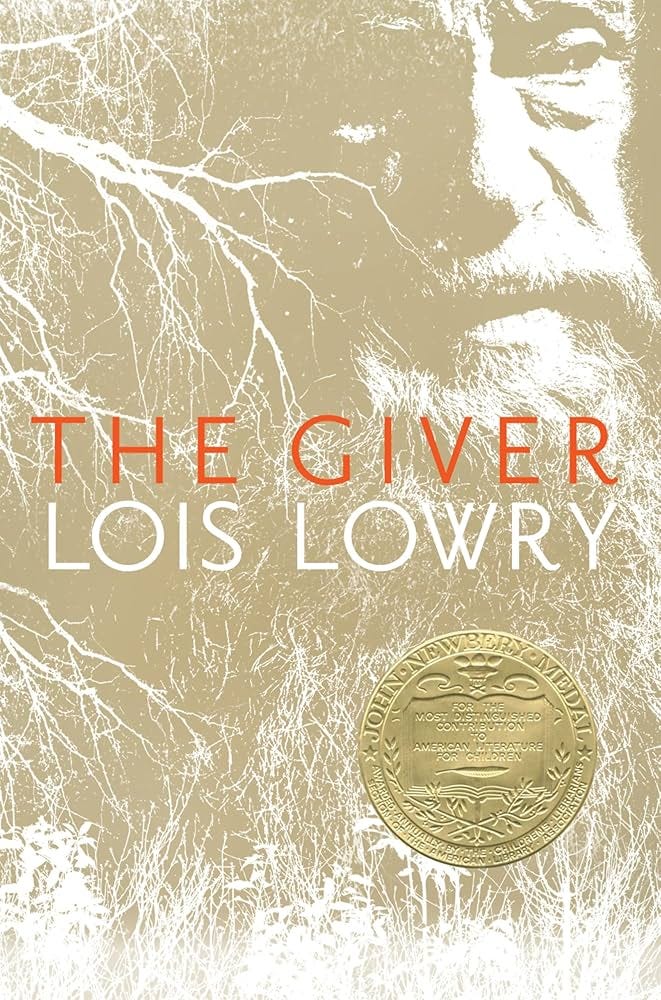
Hungry for Feelings
by Meg Oolders of Beautiful, Daring, Stupid
“Then, in the same way that his own dwelling slipped away behind him … the dream slipped away from his thoughts. Very briefly, a little guiltily, he tried to grasp it back. But the feelings had disappeared.”
I can’t recall how old I was the first time I read The Giver, but I suspect I was around the age of its protagonist, Jonas, who at the start of the story is feeling nervous about the upcoming Ceremony of Twelve where he, along with the other twelve-year-olds in his group, will be given his Life Assignment by The Committee of Elders in front of the entire Community.
Catching the sci-fi, dystopian vibe yet?
But Jonas is in for an uncomfortable surprise at this year’s Ceremony. He is not going to be given a typical job Assignment like his friends. The Committee of Elders has selected him, for his observed intelligence, integrity, courage, and his rare Capacity to See Beyond, to be the next Receiver of Memory. A great honor.
Under the guidance of his predecessor, a man known only to Jonas as The Giver, Jonas will learn why life in the Community is so comfortable. Why everything works out so well. Why no one is lonely. Or vengeful. Or hungry. Or sick. Why no one fears pain or death or wonders if they’re meant for something—or someone or somewhere—else.
“Life here is so orderly, so predictable—so painless. It’s what they’ve chosen.”
I picked this book up again several years ago. As a writer of young adult fiction, I had become deeply concerned about book banning, particularly with regard to stories written for and about young people and decided to build my TBR from banned titles, both as a sign of support to their creators and as an exploration into why these books were being pulled from shelves in the first place and out of reach of the readers who would benefit most from them.
The Giver has been challenged over 11,000 times since its publication in 1993, with a fresh surge of attention following the release of its film adaptation in 2014. While middle grade and YA titles are most often flagged for containing adult language or sexually explicit content, The Giver was simply deemed “unsuited to the age group,” in other words too “dark” for its intended readership, particularly in its depictions of war, suicide, and euthanasia (termed “release” in the text) of both the elderly and infants.1 The book also addresses the frailty of a homogenous society built on the sequestration of history and the erasure of uniquity.
It would not escape a rebellious reader’s notice that the primary notion being withheld from the book’s fictional society is their violent and colorful past, and more specifically … the books that contain record of it.
“Our people made that choice, the choice to go to Sameness. We relinquished color when we relinquished sunshine and did away with differences. We gained control of many things. But we had to let go of others.”
So, what does a forty-something romance writer with a penchant for steam and satire find so loveable about this decades-old dystopian diamond?

Precision of Language
“He made himself say the words, though he felt flushed with embarrassment. ‘Do you love me?’ There was an awkward silence for a moment. Then Father gave a little chuckle.”
Whenever I venture into a middle grade novel, I am struck by how economical the language is. Books for young readers are shorter than those written for adults by design, but their goal of building immersive worlds full of relatable characters faced with challenging stakes remains the same.
Lois Lowry is a master of world building, and in this story she manages to pull the reader in to a world that’s both pleasantly familiar and deeply unsettling from page one, as Jonas recalls a recent incident involving an airplane flying over the community, which is highly irregular, not to mention against “the rules,” and decidedly “frightening.” It is this moment Jonas recalls when he makes the mistake of thinking he is frightened about the upcoming ceremony of Twelve.
“No. Wrong word, Jonas thought.”
Apprehensive is the word Jonas eventually chooses to share at the evening’s “telling of feelings” with his family unit. Because precision of language is something all community members must strive to maintain. Using the wrong word in a situation could result in confusion, a dose of ridicule from peers or, if it happens too frequently, disciplinary action from teachers. Best to choose the right words to describe the “feelings” that arise during the day so they can be properly discussed with family and resolved before bedtime.
Lowry paints us more of Jonas’ surreal world, and its many rules, expectations, and predeterminations, over the next several chapters with minimalist brushstrokes, leaving us to speculate about what fictional (or actual) events led to our collective “decision” to do away with free will and live in perpetual “sameness.”

A Timeless Message
“If everything’s the same, then there aren’t any choices! I want to wake up in the morning and and decide things!”
Written over three decades ago, The Giver offers a glimpse of a “utopian” future for humankind, designed by committee, perpetuated by obedience, and devoid of passion. Where everyone is alive and well but no one is really living. Where everyone fits in but no one stands out. Where the first “stirrings” of desire are squelched with pills, because to want is to stray selfishly from the path set out for you from the time you are born to the time you are released.
Like most dystopian tales, The Giver is meant to caution us about what a shift toward militant uniformity would mean for our humanity. And that when we bury the lessons of our past, we render ourselves vulnerable to future threats to our survival, dooming ourselves to repeat our worst mistakes over and over again.
I’ve returned to this book, time and again, and found its message to be evergreen. It seems human beings can never have enough reminders to look Beyond what’s being put in front of us by the “committees” and individuals who curate our feeds and deliver us our “facts.” To go deeper into understanding our own experiences and the experiences of those around us. To celebrate our differences. To appreciate color, nature, music, wisdom, and the freedom to choose.

The “Love” Connection
“The community where his entire life had been lived lay behind him now, sleeping. At dawn, the orderly, disciplined life he had always known would continue again, without him. The life where nothing was ever unexpected. Or inconvenient. Or unusual. The life without color, pain, or past.”
And here’s where the romantic in me gets her due. What Jonas ultimately learns from his time with The Giver, and with each memory he is called upon to receive, is that in their quest for comfort, ease, and peaceful simplicity, the people of Jonas’ community have given up their humanity. But without the knowledge to understand what they have lost, there is no impetus to reclaim it. Things will go on as they always have.
“‘Back and back and back.’ Jonas repeated the familiar phrase. Sometimes it had seemed humorous to him. Sometimes it had seemed meaningful and important. Now it seemed ominous. It meant, he knew, that nothing could be changed.”
Throughout his training, Jonas is introduced to a wealth of new, powerful, and often excruciating emotions. Fear. Grief. Rage. Anguish. Joy. And love. It’s Jonas’ newfound desire to feel love, to take chances and face consequences, to know pain and endure suffering, to see color and hear music, and to share those long-buried gifts with others that leads him to risk every assurance of safety a life in the community promises to save his adopted brother, a “newchild” named Gabriel, from being “released.”
But neither their escape nor the road ahead will be easy.
“When he had had a choice, he had made the wrong one: the choice to leave. And now he was starving. But if he stayed … he would have starved in other ways. He would have lived a life hungry for feelings, for color, for love.”
Lowry leaves us with a sense of hope that Jonas’ sacrifice will lead to some kind of change for the people he left behind. But she also leaves us wondering, even worrying, what Elsewhere has in store for our hero and his loved one.
“All of it was new to him. After a life of Sameness and predictability, he was awed by the surprises that lay beyond each curve of the road.”
There are few books in my personal library that have received as many repeat visits as The Giver. I love it for its clarity, its constancy, and its tender embrace of the human condition.
We invite you to add your own reactions, insights, and ideas in the Comments for an impromptu book club session. Share your favorite quotes, characters, moments, and surprises in discussion with other passionate readers.
(And if you’d like to feature your favorite book in a future edition, DM me.)

 | A guest post by
|